
The New Demons
On typewriters, Cameras, and the Case Against Ease

Welcome back. I’m back to a quasi-regular rhythm. If you missed my piece from two weeks ago, make sure to check out, “What the Best Writers Do.” And if you’d like to join the community,
This essay is dedicated to Winn Collier.
1
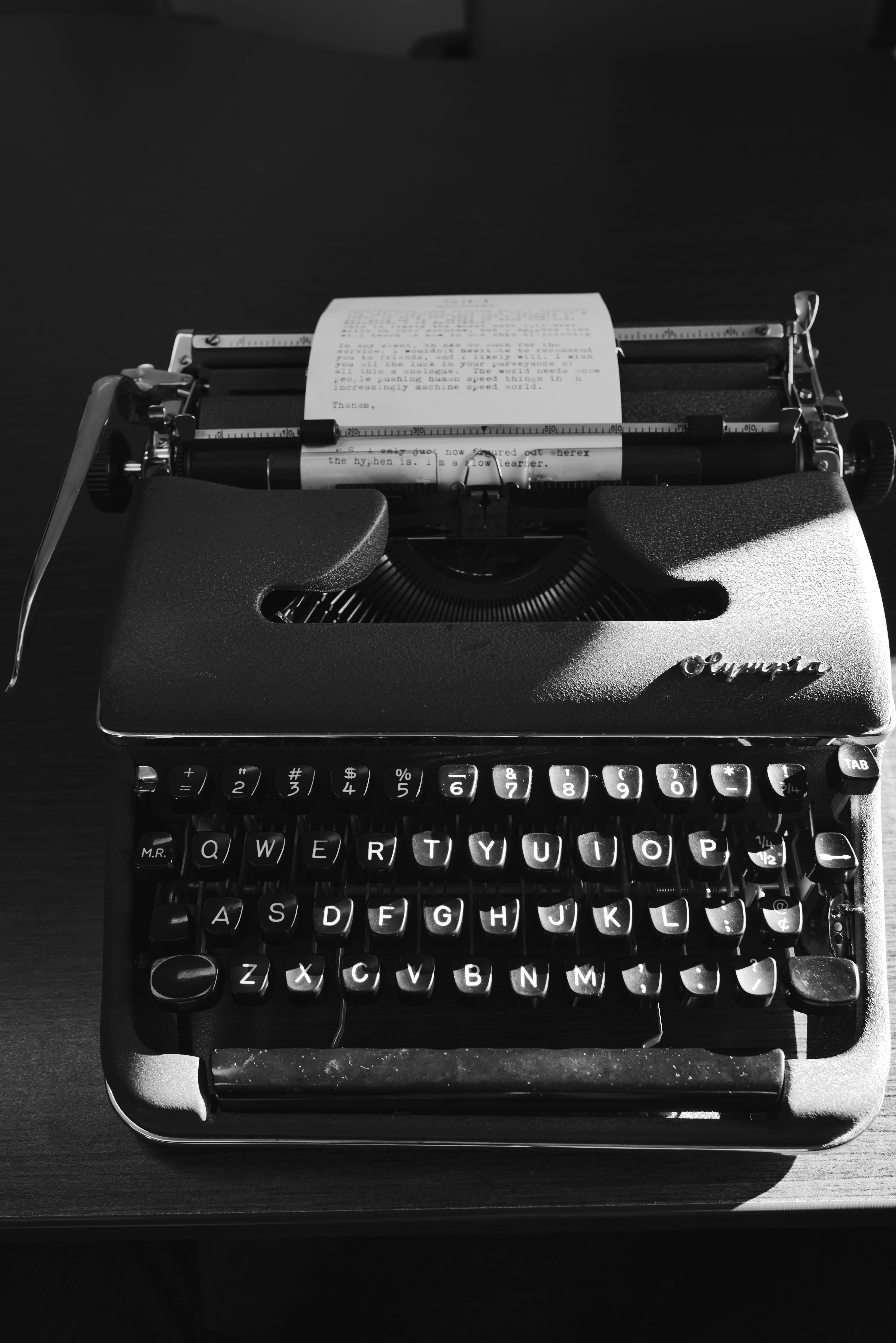
I am writing (the original piece, not the version you are reading) on a chocolate-brown Olympia SM3 from the 1950s. It’s a solid machine, one that takes a more heavy-handed approach to typing. This is because the Olympia was made by Germans in the years following a very second Great War. Germans have never been accused of being a delicate people.
Both history and Olympia tell us that the Germans continued to build tanks after disarmament. They called those tanks typewriters, and though they didn’t shoot fire from their snouts, they were heavy enough to be used as murder weapons. Every word takes effort on the machine, particularly any word containing the letter “a” or “p” because my pinkies have grown weak in my late middle years. I am a man of useless terminal appendages.
In the 1990’s, I attended Southside High School, and on the second floor of the south wing, a small middle finger branched off. The middle finger had several rooms filled with equipment used by the school newspaper. One of those rooms housed lines of yellow machines, each with sticky keys coated by years of teenage angst and Mountain Dew residue. There, we learned the basic mechanics of typing: left hand on ASDF, right hand on JKL;. Our instructor was a middle aged redhead with a bob cut whose name I don’t remember because, in the words of a classmate, She’s pretty for her age but she’s no Ms. Catsavis.
Ms. Catsavis was the Spanish teacher—muy caliente, the boys said.
Mad Men didn’t exist in those days—at least not as a television show—but if it had, Ms. Typingham could have been an extra. Cherry-red nails, polyester skirts, cream sweater sets. I imagine she’d burn down a Virginia Slim in the classroom if it wouldn’t have set off the fire alarms. She was not so much cold as she was a stickler. Arch the wrists and fingers; strike the keys like you mean it; strong pinkies, class. Ms. Typingham would be dissapointed to know that my pinkies are soft.
The room in the middle finger of the south wing was a raucous, rhythmic room. It rat-a-tatted, dinged, and slide-chunked, and it was the only class I can recall the teacher giving us a free pass to curse. There was lots of cursing because Ms. Typingham also required perfection.
There were free typing days where we were allowed to type whatever we wanted. Those days produced many lewd sentences at the fingers of hormonal idiot boys. A few of the girls wrote terrible poetry because that’s what hormonal girls did in the ‘90s. Our instructor cared little, so long as our fingers were moving and we kept our pinky strokes strong. Type what you love and you’ll always be typing. I still mine gold from that advice.
Thirty years ago, we learned to type on mechanical machines. Thirty years ago, there was no autocorrect, no soft keyboards, no easy words. Thirty years ago, writers—real by-God writers like McCarthy and Vonnegut and Bradbury—typed long manuscripts over grueling, hand-cramping hours. These authors were not only masters of craft; their pinkies were sturdy hammers.
2
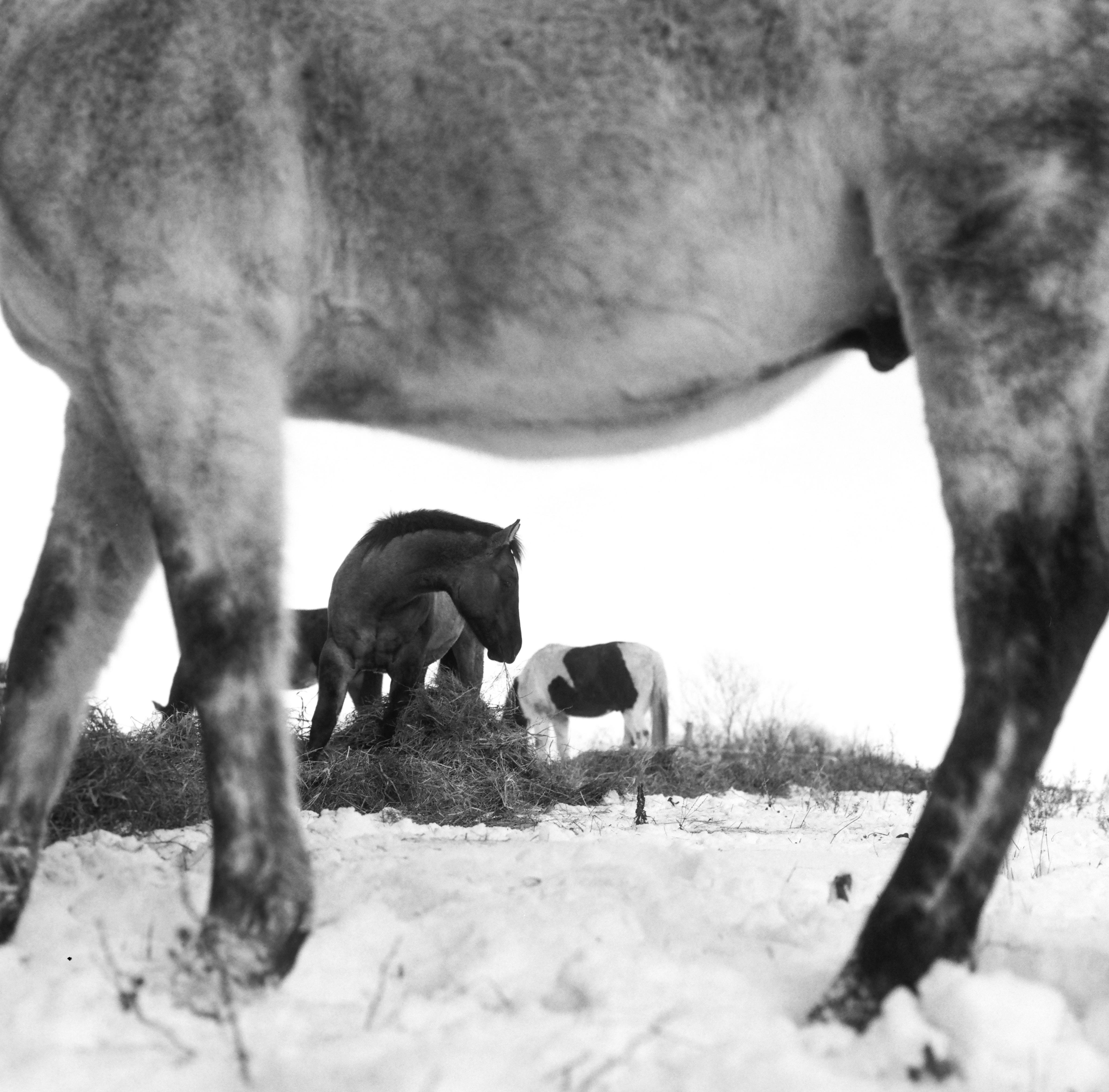
In college, I took two semesters of photography because electives were required—and odd irony of the college experience—and Bowling 101 seemed like a waste of time. For my photography classes, I rented a Pentax K1000—a camera made in Japan also after the Second War. I learned the mechanics behind the art of photography : aperture; shutter speed; the substance of composition. There were long evenings in the darkroom bathing my filmstrips in chemicals. I watched as light and shadow emerged on photo paper in a large red tub. That semester I came to believe in magic because I saw it.
There were limitations to photography in those days. You could not shoot what was not there. You shot what you shot, and if you understood the language of light, the final image made the viewer feel something because the image was—in the most literal sense—real. An entire catalogue of photojournalist and documentarians carved out careers capturing the real on their little strips of magical film and selling those images to Time or Life or even the Arkansas Democrat Gazette.
In those years, I collected photographs as if they were baseball cards. I had a journal with Xerox copies of photos from Bresson, Adams, Frank, and Lange. These were the masters, and they’d spent years honing their craft to show the world as it was, not as it should be.
Thirty years ago there were no presets, no easy ways to airbrush or clone or enhance the size of any body part. Thirty years ago, there were no easy images—even photos from a Kodak instant camera had to run through the Walmart photo lab. Thirty years ago, photographers—real by-God photographers—spent hours walking, searching for a photo-worth scene. Their eyes were trained, and their timing was tuned to the millisecond.
3
Welcome—you great hulking masses of drifting humans—into a garbage age.
In the turn lane on my morning drive, I see a middle-aged man resting his weak wrist on the steering wheel. I examine my own weak wrist, my useless pinkies. How did we earn such lazy bones and who even needs arched wrists or strong pinkies anymore? Who needs to learn the pressure it takes to pound keys? Who even needs to type? Speak a word into your magic black box and watch an LLM—the great Literary Lying Machine—make the sentence. Call the sentence your own.
A woman stands in front of the coffee shop, smiling for her black box. A professional selfie-ist cataloguing another eight-dollar latte. Who needs to learn the exposure triangle, the limitations of film speed, the way of negatives in a chemical bath? Take a photo with your phone. Upload it to the cloud. Ask the app to make the edit. Call it real.
This is where we’ve come: offload so much time, so much effort, so much humanity onto the shoulders of the artificial god; watch the artificial god work its magic; take credit for the magic; move on to the next easy act of fast and fungible creativity.
So many lament the advent of Fast Fashion, the throw-away clothing that piles up in our closets and landfills. But what about Fast Creation? Has it robbed us of our ability to create the real?
God bless the garbage age.
4
When I was kid, there were no trigger warnings. Trigger warnings came along sometime in my thirties, about the time we started taking selfies and our pinkies grew weak. And though I’m not here to give a formal trigger warning, let me say this: What follows might get a little dark.
Last week, the world minted its first trillionaire. The move from B—as in Billionaire—to T—as in Trillionaire—is a consequential one. Having a net worth between $1.2 and $1.3 trillion, the world’s richest man now has a net worth larger than the annual Gross Domestic Product of Switzerland. God bless the Swiss.
Here’s the path to becoming a Trillionaire: create electric cars; make them self-driving; build a rocket ship and aim for Mars; develop your own Al. Do these things well enough, and you’ll become a global power, an entity of one.
This week, a friend’s sixteen-year old daughter noted that the Tesla founder and Burning Man enthusiast could write the check to end global hunger for a year, and he’d still be a nrillionaire. I said, The poor you will always have with you; c'est la vie.
Once, Elon Musk tried to warn of us about AI.
AI is a fundamental existential risk for human civilization, and I don't think people fully appreciate that, he said.
AI is far more dangerous than nukes. Far. So why do we have no regulatory oversight? This is insane, he said.
You know all those stories where there’s the guy with the pentagram and the holy water and he’s like... yeah, he’s sure he can control the demon, [but] it doesn’t work out. He said this too.
Speaking of demons, in the same week Musk became a trillionaire, a local photographer was arrested for allegedly using AI to create pornographic images of school-aged children. I do not know the details of the case, but here’s what’s been reported by the news sites: the Arkansas photographer summoned a demon through the platform the world’s first trillionaire created. Maybe the world’s richest man can wash that news down with a glass of Dom Pérignon. Maybe a spoonful of caviar will settle his stomach.
The age of the digital gods may usher in a golden future, at least this is what the AI optimists hope. It may decrease mortality rates, cure cancer, grow wealth—whatever. But maybe these same platforms have made everything a little too easy. Easy words. Easy ideas. Easy images. Maybe this ease has robbed of something—strong pinkies, the techniques of the masters, a moral compass that’s governed by human limitations. Maybe AIs like Grok are in the process of turning us into slaves—first to ease, then to our own desires, and ultimately to the AI itself.
There are men banking on this last set of probabilities. They have a vested interest in the new slavery. See them on sleek ships, cackling like hyenas.
The K-1000 is perhaps the greatest SLR ever made (but less tough than the TOPCON).
Just telling my leader last night that my handwriting was so terrible in elementary school I had to type everything out. And now at 69 I can read just about anyone's scribbles and am willing to type out stuff as needed